By Laura Matthew
First aid at work can feel confusing, but it doesn’t have to be.

First aid at work isn’t optional - it’s a legal requirement.
But if you’ve ever tried to figure out exactly what you’re supposed to provide, you’ll know it can feel a bit…vague.
How big should your kit be? Do you need more than one? What about catering areas, drivers or warehouse staff?
You’re not the only one asking these questions, so let’s break it down in a straightforward, no‑nonsense way.
So, what does the law actually say?
Under the Health and Safety (First-Aid) Regulations 1981, every UK employer must provide “adequate and appropriate” first aid equipment.
That wording is deliberately broad. There’s no universal shopping list because a ten‑person office doesn’t face the same risks as a busy warehouse or a hot, fast‑paced kitchen.
What you do need is:
-
The right equipment for your environment
-
Easy access to it
-
Regular checks and restocking
-
A proper first aid needs assessment
If you can show those things, you’re already on solid ground.
What’s BS 8599‑1, and why should you care?
You’ll often see workplace kits described as “BS 8599‑1 compliant”. That’s simply the British Standard that outlines what a workplace first aid kit should contain.
Think of it as a trusted benchmark. It ensures the kit is stocked with the right items, in the right quantities, for real‑world injuries.
Using a BS 8599‑1 kit makes it much easier to demonstrate you’ve taken reasonable steps to meet your legal duties.
At Astral Hygiene, all our workplace kits meet this standard.
How do you know which kit size is right?
Instead of getting bogged down in categories, start with a few simple questions:
-
How many people are usually on site?
-
Are you spread across multiple floors or buildings?
-
Do customers or visitors come through regularly?
More people and more space usually means more than one kit.
Then think about the type of work you do.
-
Office environments: mostly minor cuts, slips and paper‑related mishaps. A small or medium kit is usually enough.
-
Retail, workshops or light manufacturing: a medium kit is a sensible minimum.
-
Warehousing, engineering or construction: larger kits are often needed, and if heat is involved, a dedicated burns kit is essential.
It’s not about overcomplicating things. It’s about matching your kit to the risks your team actually faces.
Don’t forget specialist environments
Some workplaces need a little extra thought.
-
Catering: blue detectable plasters are a must, so a catering kit is the safest option.
-
Heat, welding or hot surfaces: burns treatment should be front and centre.
-
Drivers, engineers or lone workers: they need their own kit.
Once you look at how your team works day to day, the gaps become much clearer.
A first aid kit is only compliant if it’s complete
Buying the kit is the easy part.
Keeping it stocked is where many businesses slip up.
Dressings get used. Plasters disappear. Expiry dates creep up. And it’s only when someone reaches for something in an emergency that they realise it’s missing.
Regular checks, simple documentation and having refill packs ready make a huge difference, for compliance and for peace of mind.
Why it really matters
Yes, compliance protects your business. But more importantly, it protects your people.
In those first few minutes after an accident, the right equipment can reduce the severity of an injury and prevent complications. A relatively small investment can genuinely save a life.
Keep It Simple. Keep It Compliant.
At Astral Hygiene, we supply BS 8599‑1 compliant workplace kits, catering kits, burns kits and vehicle kits - everything you need to stay prepared without overthinking it.
If you’re unsure whether your current provision is adequate, now’s a great time to review it.
First Aid Kits
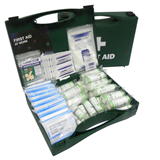
Keep everyday first-aid supplies together with the 10 Person First Aid Kit. Its green case has a carry handle and clear First Aid marking, providing an identifiable place for essentials such as plasters, dressings, bandages, wipes and gloves. The portable format helps colleagues take supplies to where they are needed while keeping the kit organised between uses.
Use the 10-person designation as a starting point when selecting provision for a small team. Check your workplace first-aid needs assessment, including the activities, hazards and people involved. Keep the kit accessible, make its location known and inspect the contents regularly, replacing used items and anything expired or damaged.
Organise your workplace first-aid point with the 20 Person First Aid Kit. Supplied in a green carry case with a wall-hanging bracket, it brings adhesive plasters, eye pads, triangular bandages, safety pins, gloves, dressings and cleaning wipes together. A first-aid leaflet is also included, while the handle makes the case easy to take to the area where assistance is needed.
Choose the 20-person size alongside your workplace first-aid needs assessment. Consider the activities, hazards and people on site, and provide any additional equipment or trained support identified by that assessment. Keep the kit accessible and check supplies regularly so used, expired or damaged items can be replaced promptly.
The X Large Catering First Aid Kit is Aero Healthcare’s HSE-50C, a 50-person kit for kitchens, food preparation areas and hospitality workplaces. It brings blue detectable plasters, wound dressings, eye pads, triangular bandages, saline wipes, disposable nitrile gloves and a first-aid guide together in a portable case. A wall bracket provides a designated storage point, while the carry handle helps staff take the kit to where it is needed.
Select this kit alongside your workplace first-aid needs assessment, considering staff numbers, shift patterns and the hazards in each work area. Keep supplies accessible, explain their location to colleagues and check the contents regularly. Replace used, expired or damaged items promptly.
This blog was written by Laura Matthew, Operations Administrator at Astral.
Please get in touch if there are any particular topics you would like us to talk about on the blog!



Comments
Post a Comment