By Sam Dyer
If you've ever compared laundry detergents or professional cleaning products, you've probably come across terms such as bio, non-bio, enzymatic and biological.
But what do these terms actually mean?
The short answer is that biological cleaning products use enzymes or microorganisms to help break down organic soils, while non-biological products don't rely on enzymes in the same way.
Understanding the difference can help you choose the right type of cleaner for the job, particularly when you're dealing with stubborn stains, odours, grease or organic waste.
What Does "Bio" Mean?
In cleaning products, bio is short for biological.
A biological cleaner contains biological ingredients, most commonly enzymes, which help break down particular types of organic matter.
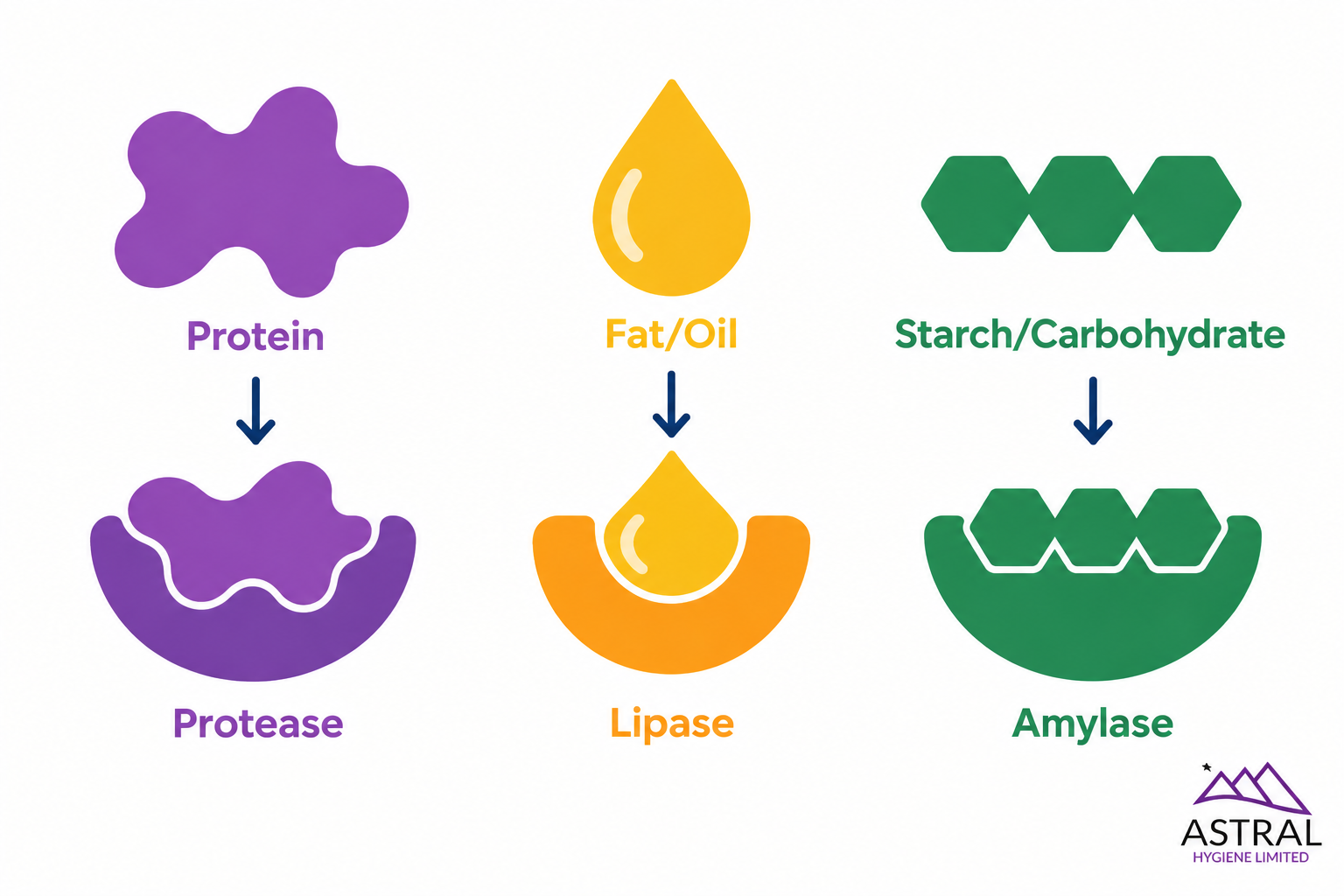
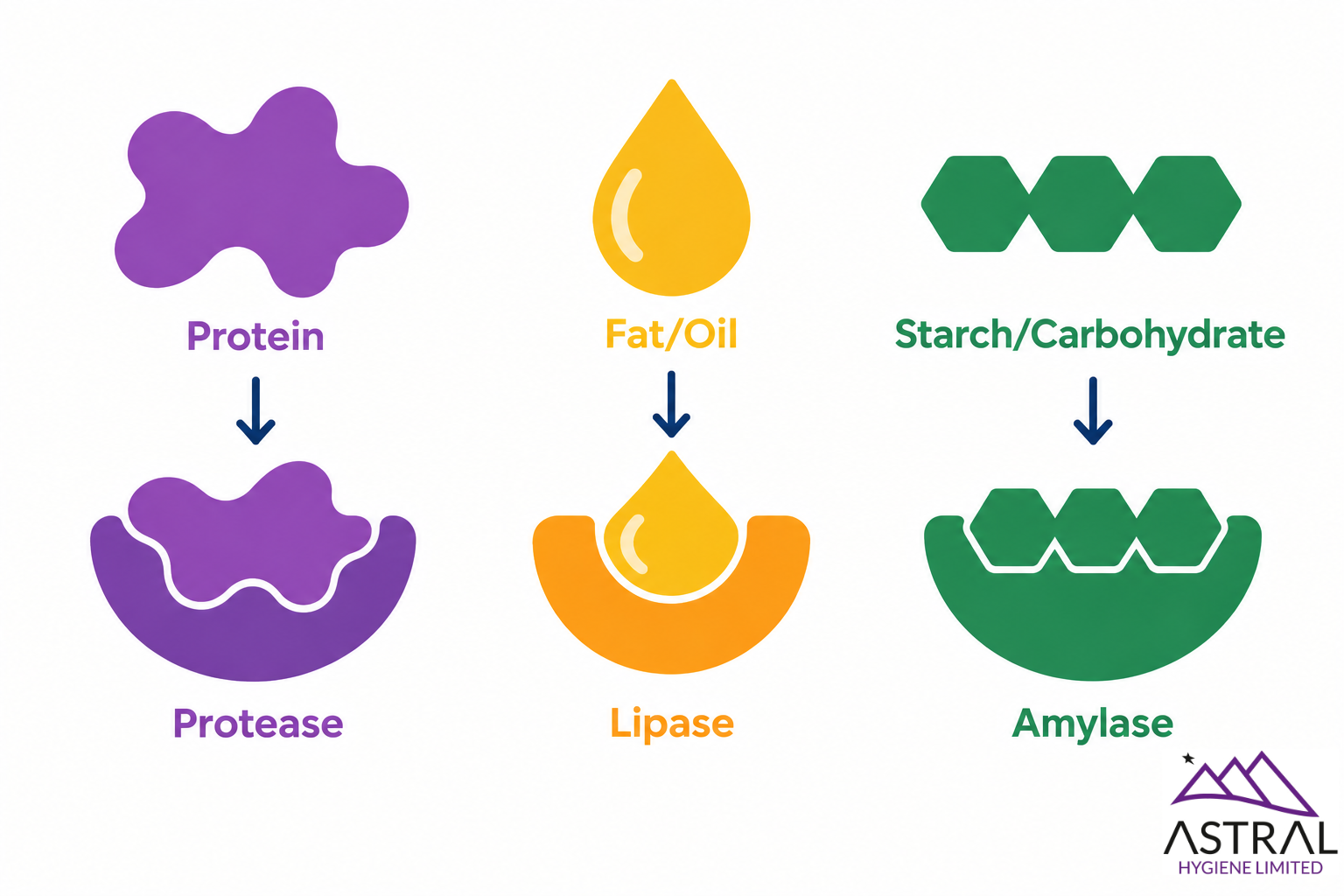
Different enzymes work on different substances. For example:
- Proteases break down proteins
- Lipases break down fats and oils
- Amylases break down starches and carbohydrates
This means an enzymatic cleaner can be particularly useful when you're dealing with organic soils such as food, grease, bodily fluids or other biological residues.
Bio laundry detergents commonly use a combination of enzymes to help tackle a broad range of stains. We stock professional biological laundry products which use enzyme-based formulations to target stains such as grease, food and protein.
So What Is Non-Bio?
Non-biological, or non-bio, cleaning products don't contain enzymes.
That doesn't mean they aren't effective cleaners. Non-bio detergents use other cleaning ingredients, such as surfactants, builders and other chemical components, to lift and remove dirt.
Our Professional Non-Bio Laundry Detergent, for example, is an enzyme-free and fragrance-free formulation designed for commercial laundry. It is suitable for clothing, towels, bedding, linen and other washable textiles.
Non-bio laundry products can be useful where an enzyme-free formulation is preferred, including situations where laundry is being processed using high-temperature washes.
Bio-Productions Non-Bio Laundry Liquid is a professional laundry detergent in a 5-litre container. The NBLL product is non-biological and formulated without enzymes, offering a liquid option for commercial washing routines where a non-bio detergent is preferred. Use it for compatible clothing, workwear, bed linen and table linen in accordance with the items’ care instructions.
Measure the dose from the supplied container’s guidance, allowing for the size and condition of the load and your water hardness. Choose the wash programme and temperature for the fabrics rather than using one setting for every job. Keep the container labelled and securely closed, and follow its handling and storage instructions when replenishing the laundry area.
Enzymatic vs Chemical Cleaning: Is There Really a Difference?
This is where things can become confusing.
It's tempting to think of enzymatic cleaners as "biological" and everything else as "chemical", but that's an oversimplification.
Enzymes are themselves chemicals, and biological cleaning products can contain conventional cleaning ingredients alongside enzymes.
The more useful distinction is between the type of cleaning action taking place.
An enzymatic product uses enzymes to target specific organic substances, whereas conventional cleaning products may rely on ingredients such as surfactants, acids, alkalis or solvents to loosen, dissolve or remove soils.
In other words, it's not really "biological versus chemical". It's more about which cleaning mechanism is being used and what you're trying to remove.
How Do Enzymatic Cleaners Work?
Enzymes are specialised molecules that accelerate, or catalyse, specific chemical reactions.
In a cleaning product, they can act on particular types of organic soil. For example, a protease can break down protein-based stains into smaller components that are easier to remove during cleaning.
This can be particularly useful for stains and contamination that contain organic material.
Some biological cleaners also contain microorganisms that produce enzymes. These products can be useful in applications where organic material and odour are the main problems.
For example, Micro Clean uses specially selected microorganisms that produce enzymes to break down organic soiling and help neutralise odours. It is intended for applications including carpets, upholstery, fabrics and flooring affected by organic contamination.
Micro Clean is a biological stain and odour cleaner supplied in a 1L bottle. Its microorganisms produce enzymes that help break down organic soiling in suitable carpets, upholstery, fabrics and flooring. It is intended for absorbed spillages and odour sources, including body-fluid contamination, where the cleaning solution can reach the affected material.
Check colourfastness and material compatibility before treatment, and follow the current label for dilution. Apply the solution so it penetrates the soiling; the manufacturer specifically says not to spray it. Allow the treated area to dry naturally without rinsing as directed. This helps distinguish Micro Clean from routine spray-and-wipe products when choosing a treatment for a particular stain or odour.
When Are Biological Cleaners Useful?
Biological and enzymatic products can be particularly useful when the contamination contains organic material.
Common applications include:
🧺 Laundry
Bio laundry detergents are designed to tackle a range of common organic stains, including food, grease and protein-based marks.
They're widely used for everyday laundry where stain removal is important, particularly when washing at temperatures within the product's recommended operating range.
🚽 Washrooms
Biological cleaning products can be useful for tackling organic residues and persistent odours in washroom environments.
Some products use microorganisms and enzymes to break down organic matter rather than simply masking unpleasant smells.
🍔 Food and Catering Areas
Food preparation environments can generate significant amounts of organic waste, including fats, oils, proteins and food residues.
Enzymatic products can have applications in areas such as drains and grease traps. Biological Drain Solution, for example, uses enzymes to break down grease, fats and food waste while helping to control drain odours.
🛋️ Carpets and Upholstery
Organic spills can be particularly difficult to remove once they have soaked into fabrics.
Biological cleaners can be useful for treating certain stains and odours caused by substances such as food, bodily fluids and other organic contamination.
Biological Drain Solution 5ltr is a professional biological treatment for small-bore drains serving sinks, baths, showers and kitchen waste units. Bio-Productions combines selected microorganisms with enzymes to break down organic waste, including fats and grease, helping improve flow and reduce associated odours. The 5L container suits a regular maintenance routine for catering and other premises with recurring organic deposits.
Shake before use and follow the manufacturer’s measured treatment method. A 50 ml dose is applied at the outlet, activated with water and left for at least 30 minutes, ideally overnight, before flushing. Weekly maintenance also uses 50 ml. Keep treatment separate from bleach, disinfectants, acids and caustic products, which can interfere with its biological action.
When Might a Non-Bio Product Be the Better Choice?
There are also plenty of situations where a non-biological product is appropriate.
For laundry, non-bio detergents can be useful when an enzyme-free formulation is preferred. This can be particularly relevant where a laundry process uses high temperatures for hygiene or sanitisation.
High-Temperature Laundry
Temperature is an important consideration when using enzymatic products because enzymes are biological molecules whose activity can be affected by heat. Many cleaning enzymes work within particular temperature ranges, and sufficiently high temperatures can reduce or destroy their activity.
This means that where laundry is being processed using a high-temperature wash as part of a sanitising or thermal disinfection process, an enzyme-free detergent can be a practical choice. The cleaning performance then doesn't depend on enzymes remaining active at those elevated temperatures.
This doesn't mean that bio detergents cannot be used at higher temperatures. Some are specifically formulated for a range of wash temperatures. The important point is to follow the manufacturer's stated temperature range and washing instructions.
It's also worth remembering that the detergent and the sanitising process have different roles. A non-bio detergent does not automatically sanitise laundry simply because it is enzyme-free. Where thermal disinfection is required, the wash temperature, exposure time and complete laundering process need to meet the relevant requirements.
Our Non-Bio Laundry Powder is suitable for commercial washing machines across a range of wash temperatures.
Vital Fresh Aloe Vera Non-Bio Laundry Powder is supplied in a 10kg box for regular laundry washing. The non-biological powder provides a bulk detergent option for suitable machine-washable clothing, towels and bed linen. The bulk pack gives businesses a practical detergent supply for their everyday laundry routine.
Use it in a compatible washing machine according to the instructions on the supplied pack. Sort laundry before washing and choose the dose and programme to suit the fabric care label, load size, soiling and local water hardness. Measure the powder carefully, keep the packaging closed and dry between uses, and maintain a consistent washing routine in your hotel, guest accommodation or workplace laundry area.
Bio Doesn't Mean "Natural"
Another common misconception is that biological automatically means natural or chemical-free.
It doesn't.
Biological cleaning products can contain enzymes or microorganisms alongside other cleaning ingredients, and enzymes themselves are chemical substances.
Similarly, a non-biological product isn't necessarily harmful or harsh simply because it doesn't contain enzymes.
The important thing is to look at the specific formulation and intended use of the product, rather than relying on the word "bio" alone.
What About Temperature?
Temperature can be an important consideration with enzymatic cleaning.
Many enzymes perform particularly well within specific temperature ranges. Excessive heat can reduce enzyme activity, which is one reason certain biological laundry detergents are designed to provide effective cleaning at lower or moderate temperatures.
For example, many bio laundry detergents are suitable for washing at temperatures as low as 20–30°C.
However, this doesn't mean that all bio detergents have the same temperature limitations. Always follow the instructions for the particular product you're using.
If a laundry process requires a high-temperature wash for hygiene or thermal disinfection, check that the detergent is appropriate for the process and that the required temperature and exposure time are achieved independently of the detergent.
Can You Use Bio and Non-Bio Products Together?
Generally, you shouldn't assume that different cleaning products can be mixed.
Whether products are compatible depends on their formulations and intended use. Mixing chemicals without confirmation from the manufacturer can produce unwanted reactions or reduce cleaning performance.
Instead, use products according to their individual instructions and don't combine cleaning chemicals unless the manufacturer specifically states that they are compatible.
Which One Should You Choose?
There isn't a universal winner between biological and non-biological cleaning products.
The right option depends on what you're cleaning, the type of contamination and the cleaning process you're using.
| |
|
| If you're dealing with... |
You might consider... |
| Protein-based stains |
Enzymatic cleaner |
| Food and organic stains |
Biological/enzymatic product |
| Grease and fats |
Enzymatic or dedicated degreasing product |
| Organic odours |
Biological odour-control product |
| General laundry soil |
Bio or non-bio laundry detergent |
|
High-temperature laundry processes
|
An appropriate non-bio or other enzyme-free detergent
|
| Enzyme-free laundry requirement |
Non-bio detergent |
| |
|
The important thing is to match the cleaning method to the problem and the process rather than choosing a product simply because it's labelled "bio" or "non-bio".
Biological and Non-Biological Cleaning at Astral Hygiene
We stock a range of biological and non-biological cleaning products for commercial and professional applications.
These include biological laundry detergents, enzyme-based drain treatments and biological stain and odour products, alongside non-bio laundry detergents and conventional cleaning chemicals.
This gives you different approaches depending on the type of cleaning you're carrying out, the contamination you're dealing with and, for laundry, the temperatures and processes involved.
The Bottom Line
Bio and non-bio products aren't simply a case of one being better than the other.
Biological and enzymatic cleaners can be particularly useful for organic stains, grease, food residues and certain odours, because enzymes can target specific types of organic material.
Non-bio products take a different approach and can be useful where an enzyme-free formulation is preferred, including some high-temperature commercial laundry processes.
Understanding what you're trying to remove and how the cleaning process will be carried out is the best place to start. Once you know whether you're dealing with grease, protein, general dirt, organic waste or another type of soil, you can choose a cleaning product and process designed to tackle the problem effectively.
This blog was written by Sam Dyer, Operations Administrator at Astral.
Please get in touch if there are any particular topics you would like us to talk about on the blog!





Comments
Post a Comment